Dubai 22/7/2026 – The legislative momentum surrounding what was slated to be landmark US digital asset legislation has encountered a severe roadblock in the Senate. Following the release of updated draft text by Senate Republicans and an escalating standoff over executive ethics and market structure provisions, prediction market odds for the Digital Asset Crypto Clarity Act passing in 2026 have plummeted to 39%.
Once viewed as a near certainty to cross the legislative finish line before Congress upcoming August recess, the bill has become tangled in a web of partisan disputes, Senate filibuster arithmetic, and intense lobbying from both traditional banking institutions and digital asset advocacy groups.
As Senate Majority Leader John Thune and key Republican sponsors race against the legislative clock, the sudden drop in probability highlights the complex challenges of regulating a trillion dollar decentralized industry within traditional political machinery.
The Genesis of the Clarity Act From House Triumph to Senate Friction
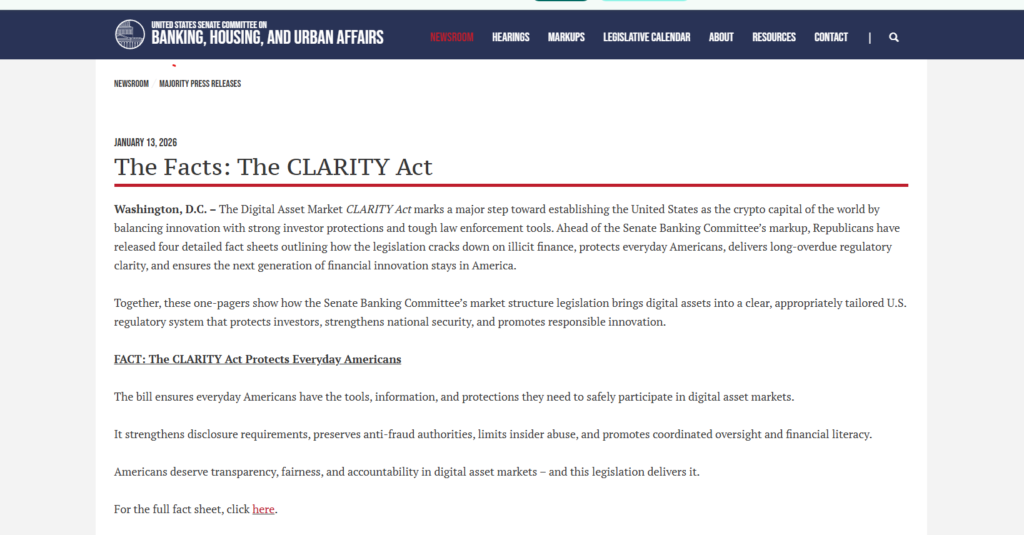
The Digital Asset Market Crypto Clarity Act H.R. 3633 was conceived to replace years of “regulation by enforcement” with a statutory framework for digital assets in the United States.
For nearly a decade, crypto firms, investors, and legal scholars criticized federal regulators most notably the US Securities and Exchange Commission SEC for lacking clear definitions regarding when a token transitions from a security into a digital commodity.
In July 2025, the legislation achieved a historic milestone when the House of Representatives passed the CLARITY Act by a bipartisan vote of 294 to 134. The House bill gained the support of every voting Republican and 78 Democrats, establishing a baseline for momentum.
Following the passage of the GENIUS Act which created a federal regulatory regime for payment stable coins the CLARITY Act was viewed as the crucial second pillar needed to solidify American leadership in global financial technology.
| Stage / Committee | Action Taken | Key Vote / Posture |
| House Floor | Passed H.R. 3633 | 294–134 (Bipartisan passage) |
| Senate Agriculture Committee | Approved Digital Commodity Version | Bipartisan Approval (CFTC Spot Market Jurisdiction) |
| Senate Banking Committee | Approved Market Structure Text | 15–9 Vote (May 2026 markup) |
| Senate Floor (Current Posture) | Negotiations ahead of August Recess | 39% Odds on Polymarket/Kalshi |
However, as the legislation migrated from the House to the Senate differing jurisdictional priorities between the Senate Agriculture Committee which oversees the Commodity Futures Trading Commission and the Senate Banking Committee which oversees the SEC began to complicate its trajectory. Although the Senate Banking Committee advanced its updated text in May 2026 by a 15 to 9 vote, the release of the newest draft text in July exposed critical policy fractures.
Inside the New Senate Draft: Where Policy Meets Resistance
The updated draft text released by Senate Republicans aimed to integrate feedback from regulatory agencies traditional financial institutions, and industry stakeholders. However, key provisions within the draft triggered pushback across multiple fronts.
The SEC vs CFTC Division & Decentralization Test
The draft establishes a statutory framework distinguishing between digital commodities and investment contract assets.
- CFTC Jurisdiction: Grants the CFTC exclusive spot market oversight over digital commodities that run on mature, decentralized blockchain systems such as Bitcoin and Ether.
- SEC Jurisdiction: Retains SEC authority over primary token issuances, capital raising, and non decentralized networks.
- Decentralization Safe Harbors: Establishes explicit safe harbors for core infrastructure providers including software developers, validators, sequencers, node operators, and oracle providers ensuring that writing Crypto Clarity Act open source code or maintaining consensus does not trigger broker dealer or exchange registration.
While industry advocates praised the developer safe harbors, SEC leadership and several Democratic lawmakers argued the decentralization threshold allows token issuers to bypass traditional disclosure rules prematurely.
The Stablecoin Yield Prohibition
One of the most economically contentious items in the Senate draft revolves around depository banking privileges. Under the new text, non bank digital asset platforms are prohibited from paying passive yield or interest rewards on stablecoin holdings.
Proponents including traditional banking groups argue that allowing tech and Crypto Clarity Act platforms to pay interest on risk free dollar backed tokens presents a systemic threat to traditional community bank deposits.
Conversely, crypto industry leaders contend that this restriction acts as an anti competitive shield for incumbent banks, preventing consumers from earning competitive yields on digital assets.
Crypto Clarity Act : The Executive Ethics Standoff
While technical definitions and banking provisions created policy friction, the primary catalyst that drove passage odds down from over 70% in May to 39% in July is political: a battle over executive financial conflicts of interest.
Key Context: Recent public financial disclosures revealed that President Donald Trump reported over $1.4 billion in income from digital asset projects, licensing deals, and non-fungible tokens NFTs.
This disclosure prompted Senate Democrats led by Senators Elizabeth Warren, Chris Murphy, Jeff Merkley, and Chris Van Hollen to insist that any market structure legislation include strict ethics restrictions.
| DEMOCRATIC ETHICS REQUIREMENTS |
| Mandatory Blind Trusts: Requiring the President, Vice President, and senior executive officials to place digital assets in blind trusts. |
| Issuance & Promotion Ban: Prohibiting elected officials and their immediate families from launching, endorsing or promoting branded cryptocurrency tokens while in office. |
| Comprehensive Disclosure: Requiring full transparency for active crypto holdings and corporate stakes. |
During the Senate Banking Committee considerations, a proposed amendment containing these ethics rules was defeated in an 11 to 13 vote along party lines. Senate Democrats subsequently stated that without binding conflict of interest language in the base text, they will not provide the votes needed to bypass a Senate filibuster.
- The Senate Composition: Republicans hold 52 seats in the chamber.
- Conservative Holdouts: Conservative Republican Senators such as Josh Hawley and Rand Paul have expressed reservations regarding federal regulatory expansion and CFTC market creation, effectively reducing the reliable GOP base to 50 votes.
- The 60 Vote Requirement: Under US Senate rules, ending debate on a major legislative package requires 60 votes to overcome a filibuster.
- The Democratic Gap: To reach 60 votes, Senate Majority Leader John Thune needs at least 8 to 10 Democratic senators to cross party lines.
Because Senate Democrats have closed ranks around the executive ethics issue, those needed crossover votes have stalled. Without a compromise that satisfies moderate Democrats such as Senators Ruben Gallego and Angela Alsobrooks, who supported the bill in committee the legislation lacks a viable path to passage on the floor.
Prediction Markets & Spot Prices
On prediction platforms such as Polymarket and Kalshi, contracts tracking whether the Crypto Clarity Act will be signed into law in 2026 dropped from a high of 74% in May down to 37% 39% in mid July.
Concurrently, Bitcoin BTC and broader digital asset markets have reflected this uncertainty. Analysts note that while spot prices have remained relatively range bound near the $60,000 mark, institutional investors are adopting a cautious stance pending legislative clarity.
Source: Galaxy Digital Research CLARITY Act Senate Calendar Analysis & Odds Revisions
Industry Executives Call for Compromise
Industry leaders have voiced concern that partisan disputes over ethics clauses could derail years of regulatory work.
- Mike Novogratz CEO, Galaxy Digital: Emphasized that the Crypto Clarity Act remains essential for the American digital economy, stating that lawmakers are down to wordsmithing around an ethics clause and urging both parties to compromise so the US does not lose ground to international jurisdictions.
- Summer Mersinger (CEO, Blockchain Association): Highlighted that ethics has become the elephant in the room, warning that stalling the bill leaves market participants subject to ongoing legal ambiguity.
- Market Analysts: Crypto market strategists observe that if the bill fails to clear the Senate before the August recess, market participants may have to wait until late 2026 or 2027 for another realistic legislative window. Crypto Clarity Act To understand Ethereum Is Shipping: Comprehensive Technical & Strategic Analysis of 26 Ecosystem Developments
Potential Compromise Paths Before August Recess
With Senate Majority Leader John Thune indicating a potential floor vote attempt before the August 10 recess, lawmakers face three potential scenarios:
- Adopt Narrow Ethics Compromise: Lawmakers could craft compromise text that imposes enhanced disclosure requirements and blind trust mandates for future asset holdings without targeting specific individuals. This could provide moderate Democrats the cover needed to support cloture.
- Carve Out Stablecoin Rewards: Adjusting the yield prohibition to allow non-bank entities to offer competitive reward structures tied to active usage (rather than passive storage) could satisfy crypto innovation advocates while protecting traditional banking stability.
- Delay to Late Year Lame Duck Session: If negotiations stall past the August 10 deadline, Senate leaders may shelve the bill until the autumn legislative session, though midterm election dynamics could further complicate passage.
Conclusion: A Turning Point for US Digital Asset Policy
The drop in the Crypto Clarity Act passage odds to 39% reflects the realities of modern federal policymaking. What began as a technical effort to establish regulatory boundaries between the SEC and CFTC has expanded into a debate encompassing presidential ethics, banking sector competition, and congressional math.
The next few weeks before the August recess will determine whether congressional leaders can build a bipartisan bridge or whether the U.S. digital asset industry will enter another prolonged period of regulatory uncertainty. For investors, developers, and policymakers alike, the outcome will shape the trajectory of American financial technology for years to come. To understand US national debt officially reaches all-time high of $39.5 trillion
Disclaimer: This article is for informational, educational, and analytical purposes only and does not constitute financial, investment, legal, or political advice. The legislative status of the Digital Asset Market CLARITY Act, political developments, and probability estimates from prediction markets (such as Polymarket and Kalshi) are subject to rapid change as congressional negotiations evolve. Readers should conduct their own independent research and consult qualified financial or legal professionals before making any decisions based on pending legislation or digital asset market trends.
About The Author